
Uncategorized
12V vs 24V vs 48V LiFePO4 Battery: Which Voltage Is Right for Your Application?
Oct
Voltage selection is the single most consequential specification in any LiFePO4 battery system. Get it right, and your customer builds a system that’s efficient, cost-effective, and scalable for years. Get it wrong, and they face undersized inverters, oversized wiring, premature component failures, and a call to your support line.
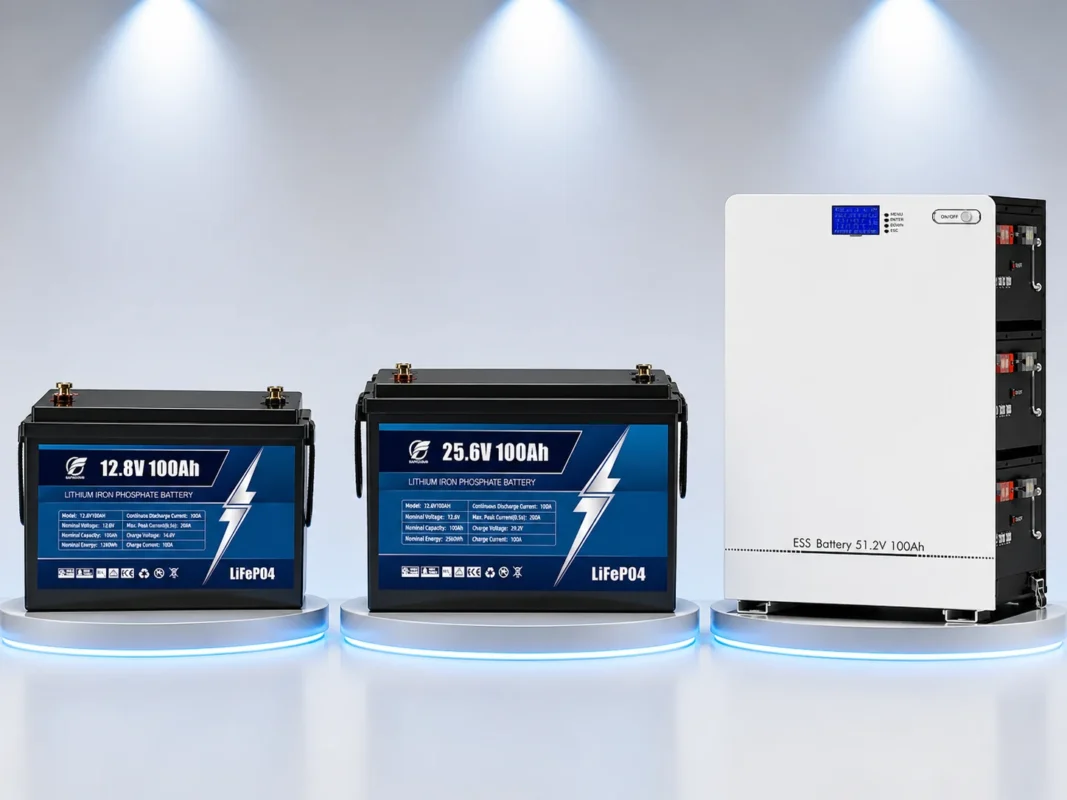
For B2B distributors, OEM brands, and system integrators, understanding the technical and commercial differences between 12V, 24V, and 48V LiFePO4 batteries is essential — not just to specify the right product, but to advise customers confidently and build long-term repeat business.
This guide gives you a complete, application-specific breakdown of all three voltage classes.
The Physics Behind Voltage: Why It Matters
The relationship between voltage, current, and power is defined by Ohm’s Law:
Power (W) = Voltage (V) × Current (A)
For a fixed amount of power delivered to a load, higher voltage means lower current. Lower current has three direct benefits:
- Less resistive loss in wiring (power loss = Current² × Resistance)
- Thinner, lighter, cheaper wiring can be used
- Lower heat generation in cables, connectors, and inverters
This is why grid-scale energy storage runs at hundreds of volts, why electric vehicles use 400V or 800V systems, and why the RV and marine industries are gradually migrating from 12V to 24V — and why residential solar storage has largely standardized on 48V.
How LiFePO4 Cells Determine Pack Voltage
Every LiFePO4 battery pack is built from individual 3.2V nominal cells connected in series:
| Configuration | Nominal Voltage | Fully Charged | Discharge Cutoff |
|---|---|---|---|
| 4S (4 cells in series) | 12.8V | 14.6V | 10.0V |
| 8S (8 cells in series) | 25.6V | 29.2V | 20.0V |
| 16S (16 cells in series) | 51.2V | 58.4V | 40.0V |
Note for technical buyers: You will often see 48V LiFePO4 batteries specified as 51.2V nominal. This is the accurate figure — 16 × 3.2V = 51.2V. The “48V” label reflects the lead-acid compatibility convention (48V lead-acid = ~51V nominal). Both terms refer to the same product class.
12V LiFePO4 Battery: Specifications and Best Applications
Technical Overview
- Nominal Voltage: 12.8V (4S configuration)
- Charge Voltage: 14.6V max
- Discharge Cutoff: 10.0–11.0V
- Typical Capacity Range: 50Ah – 400Ah
- BMS Communication: Bluetooth, RS232 (optional RS485 on larger packs)
Best Applications
RV and Camper Van
The 12V system dominates the RV market because virtually all RV appliances, lighting, and charging equipment are designed for 12V. A drop-in replacement for a Group 24, 27, or 31 lead-acid battery requires zero system modification beyond verifying charger compatibility.
Marine and Trolling Motor
Trolling motors rated below 55 lbs thrust typically run on 12V. A 12V LiFePO4 battery delivers 3× the run time of an equivalent AGM bank at 60% the weight — critical for kayak fishing and small aluminum boats where weight matters.
Small Off-Grid Cabins and Van Builds
For daily energy consumption under 1kWh, a 12V system with 100–200Ah LiFePO4 is simpler and lower-cost than stepping up to 24V. Fewer cells, simpler BMS, lower system complexity.
UPS and Telecom Backup
12V is the standard voltage for most UPS systems and telecom tower backup installations. Long calendar life and low self-discharge (❤️%/month) make LiFePO4 ideal for float-charge applications.
12V Limitations
- High current required for high-power loads (a 1,000W inverter at 12V draws ~83A)
- Cable cross-section requirements increase rapidly with power
- Not practical for whole-home solar storage above ~3kWh
24V LiFePO4 Battery: Specifications and Best Applications
Technical Overview
- Nominal Voltage: 25.6V (8S configuration)
- Charge Voltage: 29.2V max
- Discharge Cutoff: 20.0–22.0V
- Typical Capacity Range: 50Ah – 300Ah
- BMS Communication: Bluetooth, RS485, CAN (application-dependent)
Best Applications
Large Trolling Motors and Marine
Trolling motors rated 70–100 lbs thrust typically require 24V. A 24V LiFePO4 system cuts current in half compared to a 12V equivalent — meaning thinner wire runs, less voltage drop over long cable runs in larger vessels, and significantly less heat at the motor controller.
Medium Off-Grid and Solar Hybrid
For daily energy consumption of 1–3kWh, 24V hits the sweet spot. It’s efficient enough to avoid the heavy wiring of 12V, while simpler and less expensive than stepping to 48V.
Golf Cart Conversions
Many 36V golf cart systems are upgraded to 24V LiFePO4 with a controller change. For golf carts originally running 24V lead-acid banks, direct LiFePO4 replacement provides immediate range and performance improvements.
Light Commercial Backup
Small commercial UPS systems, security installations, and telecom edge nodes running 24V benefit from LiFePO4’s cycle life advantage over VRLA in high-cycle environments.
24V Limitations
- Less inverter choice than 12V or 48V (fewer models support 24V natively)
- Not ideal for large home solar storage above 5kWh
- Requires 8 cells in series — slightly more BMS complexity than 12V
48V LiFePO4 Battery: Specifications and Best Applications
Technical Overview
- Nominal Voltage: 51.2V (16S configuration)
- Charge Voltage: 58.4V max
- Discharge Cutoff: 40.0–44.0V
- Typical Capacity Range: 50Ah – 300Ah+ (stackable / expandable)
- BMS Communication: RS485, CAN 2.0, Modbus RTU (standard for inverter integration)
Best Applications
Home Energy Storage (Residential ESS)
48V is the global standard for residential solar storage systems. Every major hybrid inverter manufacturer — Deye, Growatt, Goodwe, SMA, Victron, Solax — designs their residential inverters around 48V battery input. This standardization means maximum inverter compatibility and the largest available product ecosystem.
Commercial and Industrial Peak Shaving
For C&I applications, 48V rack-mount batteries (typically 100Ah or 200Ah per unit) are stacked in parallel to reach 10–200kWh+ capacity. RS485 and CAN communication protocols allow integration with building energy management systems (BEMS).
Large Off-Grid Solar
For whole-home off-grid systems requiring 5kWh+ of storage, 48V provides the lowest practical wiring cost. A 48V/100Ah battery stores 5.12kWh at less than 100A maximum charge/discharge current — manageable with standard 50mm² cable.
Telecom and Data Center Backup
48V DC is the standard voltage for telecom infrastructure globally (ETSI and IEEE standards). LiFePO4 at 51.2V charges directly into 48V telecom systems with appropriate charge management.
48V Advantages Over Lower Voltages
- 4× lower current than 12V for identical power output
- Maximum inverter compatibility — virtually all modern hybrid inverters support 48V
- Parallel expansion — most 48V systems support 4–15 units in parallel for scalable capacity
- CAN/RS485 communication — native protocol support for smart energy management
Head-to-Head Comparison: 12V vs 24V vs 48V
| Specification | 12V | 24V | 48V |
|---|---|---|---|
| Cell Configuration | 4S | 8S | 16S |
| Nominal Voltage | 12.8V | 25.6V | 51.2V |
| Charge Voltage | 14.6V | 29.2V | 58.4V |
| Current at 1,000W | ~78A | ~39A | ~20A |
| Typical Cable Size (1,000W) | 35–50mm² | 16–25mm² | 6–10mm² |
| Inverter Choice | Wide | Moderate | Widest |
| ESS Compatibility | Limited | Moderate | Full |
| BMS Protocol | BT / RS232 | BT / RS485 | RS485 / CAN |
| Best Application | RV, Marine, UPS | Marine, Off-grid | ESS, Solar, C&I |
| Max Practical Capacity | ~5kWh | ~7.5kWh | Unlimited (parallel) |
Wiring Cost and Cable Size: The Hidden Financial Factor
For system integrators and distributors advising customers on voltage selection, wiring cost is often the deciding factor that tips the decision toward higher voltage.
Cable Cost Comparison for a 3kW System
| System Voltage | Current at 3kW | Required Cable | Cable Cost (10m run, est.) |
|---|---|---|---|
| 12V | 250A | 120mm² | $180–250 |
| 24V | 125A | 70mm² | $90–130 |
| 48V | 63A | 35mm² | $45–70 |
The cable cost difference alone can fund several years of electricity savings — and this calculation doesn’t include the cost of connectors, lugs, fuses, and bus bars, which all scale with current.
For any installation with cable runs over 3 meters and power over 2kW, 48V is the economically rational choice.
Application Decision Matrix: Which Voltage for Which Customer?
| Customer Type | Application | Daily Energy Use | Recommended Voltage |
|---|---|---|---|
| RV weekend camper | Lighting, fan, 12V appliances | < 500Wh | 12V |
| Full-time RV liveaboard | All RV loads + fridge + AC | 1–3kWh | 12V or 24V |
| Fishing kayak / small boat | Trolling motor < 55 lbs | < 300Wh | 12V |
| Larger fishing boat / yacht | Trolling motor 70–100 lbs | 500Wh–2kWh | 24V |
| Off-grid tiny home / cabin | Modest lighting + appliances | 1–3kWh | 24V |
| Residential solar home | Full home backup | 3–20kWh | 48V |
| Golf cart (standard) | 18-hole round | 1–3kWh | 48V |
| Commercial / industrial | Peak shaving, backup | 10kWh+ | 48V (stacked) |
| Telecom tower backup | Float charge, critical backup | Variable | 48V |
Series and Parallel Configurations: Scaling Your System
Understanding how batteries can be combined helps you advise customers on system expansion without requiring a full redesign.
Series Connection (Increases Voltage)
Connecting batteries in series adds voltages together:
Two 12V 100Ah batteries in series = 24V 100Ah system
Four 12V 100Ah batteries in series = 48V 100Ah system
Important: Series connection requires identical batteries (same capacity, age, and state of charge).
Parallel Connection (Increases Capacity)
Connecting batteries in parallel adds capacity:
Two 48V 100Ah batteries in parallel = 48V 200Ah (10.24kWh)
Four 48V 100Ah batteries in parallel = 48V 400Ah (20.48kWh)
Most 48V LiFePO4 systems support 4–15 units in parallel, allowing capacity to scale from 5kWh to 75kWh+ using identical battery modules.
The Scalability Advantage of 48V
A customer who starts with one 48V 100Ah LiFePO4 battery for home backup can add units to the same system as their needs grow — without replacing the inverter, rewiring the system, or buying a new BMS. This is a powerful sales argument for ESS customers considering future solar expansion.
B2B Distributor Stocking Strategy by Voltage
Based on current B2B market demand across North America, Europe, and Australia:
Recommended Inventory Mix
| Voltage | SKU Priority | Recommended SKUs | Market Share |
|---|---|---|---|
| 12V | High | 100Ah, 200Ah, 300Ah | ~40% of units |
| 24V | Medium | 100Ah, 200Ah | ~20% of units |
| 48V / 51.2V | High | 100Ah, 200Ah | ~40% of units |
2026 Trend Note
The residential solar storage market is growing 25–35% annually in most developed markets. 48V ESS battery demand is growing faster than any other voltage class. Distributors who weighted their 2022–2024 inventory toward 12V RV batteries should begin rebalancing toward 48V ESS products to capture this growth.
For OEM partners, all three voltage classes are available with custom BMS parameters, branding, and packaging — with MOQ as low as 10 units per configuration.
Frequently Asked Questions
Can I mix 12V and 24V LiFePO4 batteries in the same system?
No. Batteries of different voltages must never be connected in series or parallel. Each voltage class must form its own isolated bank. If you need to bridge two voltage buses (e.g., 12V and 48V), use a DC-DC converter — never a direct connection.
Is a 48V system safe for residential installation?
Yes. 48V is classified as SELV (Safety Extra Low Voltage) under IEC 60950 — the same safety class as 12V and 24V. The 48V threshold is considered safe for contact without special electrical safety precautions. Above 60V DC, additional safety requirements apply.
Why do 48V batteries sometimes show 51.2V on the label?
Because 51.2V is the accurate nominal voltage of a 16-cell LiFePO4 pack (16 × 3.2V). The “48V” designation is a convention borrowed from lead-acid battery standards, where a 16-cell flooded battery nominally reads 48V. Both terms refer to the same 16S LiFePO4 configuration. Most inverter compatibility specs refer to 48V, but technically accept 51.2V LiFePO4 input.
Can a 12V LiFePO4 battery be charged with a standard lead-acid charger?
Most 12V LiFePO4 batteries can be charged with a lead-acid charger in a pinch, but this is not recommended for regular use. The charge voltage of a lead-acid charger (typically 14.4–14.7V) is within LiFePO4 tolerance, but the equalization/desulfation cycle can damage lithium cells. Always use a charger with a dedicated LiFePO4 profile for regular charging.
What is the maximum cable run length for a 12V 100Ah LiFePO4 system?
At 100A continuous discharge, a 12V system should use 50mm² cable for runs up to 3 meters (one-way) to keep voltage drop below 3%. For longer runs, use 70mm² or 95mm² cable, or consider stepping up to 24V to reduce current requirements.
Can 48V rack-mount batteries be mixed with 48V floor-standing batteries in parallel?
Only if they use identical cell chemistry, capacity, BMS firmware, and are from the same manufacturer. Mismatched batteries in parallel create current imbalance that degrades all units faster. For any parallel installation, use identical units from the same production batch wherever possible.
Conclusion
The choice between 12V, 24V, and 48V LiFePO4 is not primarily a battery decision — it’s a system design decision. The right voltage depends on the application’s power demand, the length of cable runs, the inverter and charger equipment in use, and the customer’s future expansion plans.
As a general rule:
- 12V for RV, marine, and low-power off-grid
- 24V for medium marine, trolling motors, and moderate off-grid
- 48V for everything above 3kWh, all residential solar storage, and any commercial application
Understanding this framework lets you stock the right mix, advise customers with authority, and build the kind of technical credibility that keeps distributors and integrators coming back.
Safecloud Power manufactures LiFePO4 batteries in 12V, 24V,
and 48V configurations — with custom capacity, BMS parameters, and OEM branding available
across all voltage classes. View our full product range or
contact our B2B team for wholesale pricing and sample requests.
Request Wholesale Pricing or OEM Sample →
