
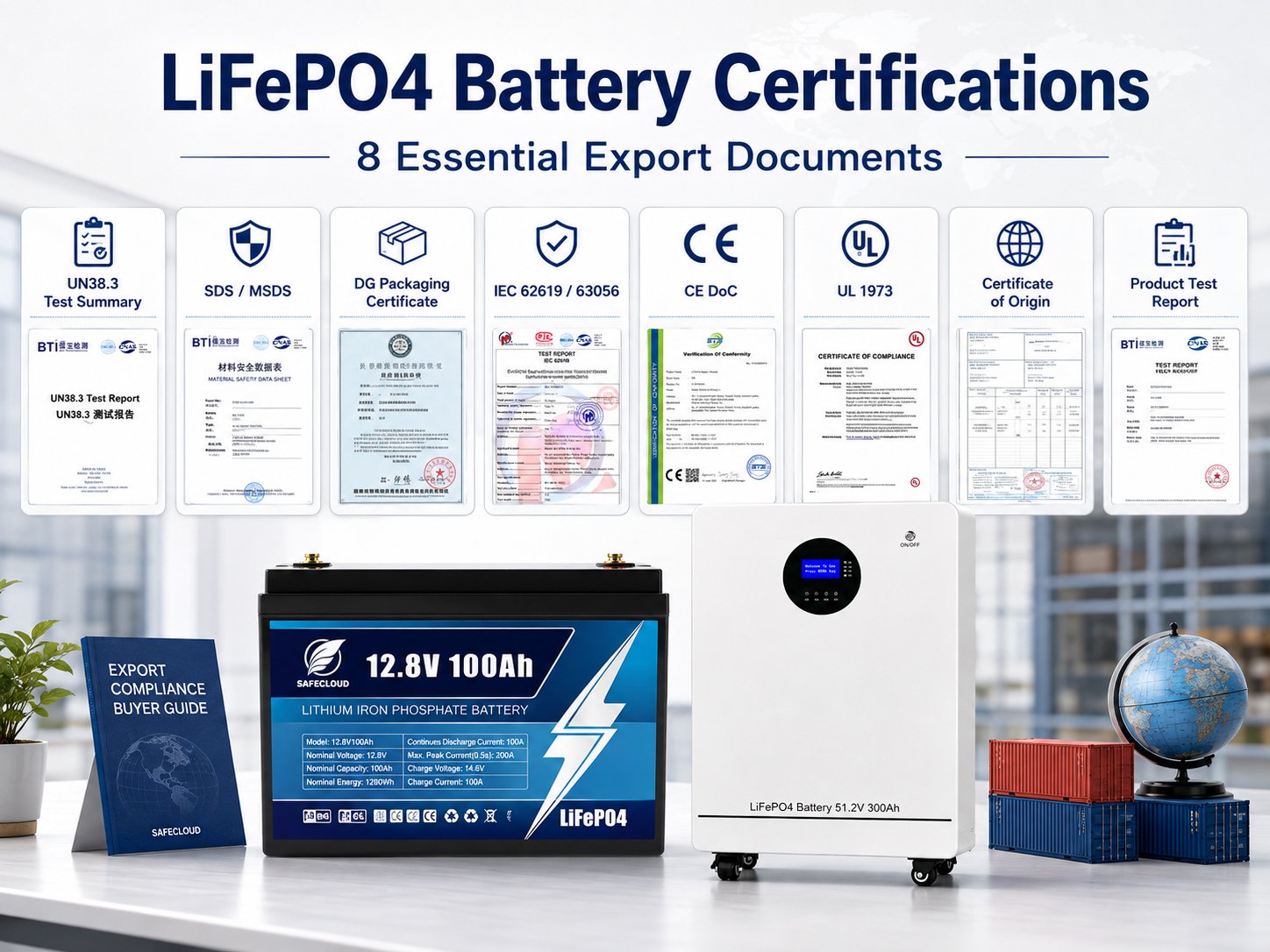
LiFePO4 battery certifications are where energy storage shipments most often stall — not at the factory, and not on the water, but at the moment a freight forwarder’s dangerous goods desk compares your paperwork against your cargo and finds they do not match. The delay is rarely caused by a missing certificate. It is caused by a certificate that exists but covers a different model, a different configuration, or a different transport mode than the one being shipped.
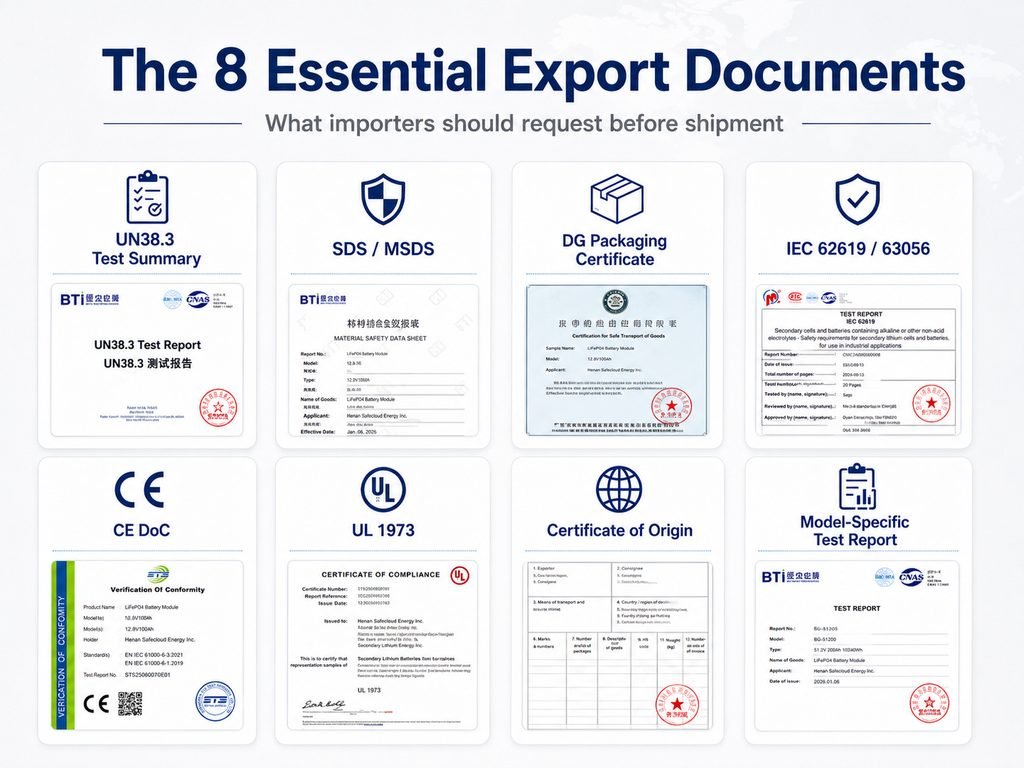
The eight documents you should expect from a LiFePO4 battery supplier are: UN38.3 Test Summary, SDS/MSDS, Dangerous Goods Packaging Certificate, IEC 62619 or IEC 63056 test report, CE Declaration of Conformity (EU lanes), UL 1973 certification (North American lanes), Certificate of Origin, and a model-specific product test report.
This guide explains what each one actually covers, what it does not cover, and the verification questions that prevent a shipment being held. It is written for importers, distributors, EPC contractors and OEM buyers sourcing lithium iron phosphate energy storage from China.
Note on scope: regulations in this area change on a fixed annual cycle — IATA publishes a new Dangerous Goods Regulations edition each January, IMDG amendments run on a two-year cycle, and the EU Battery Regulation phases in obligations through 2027. Treat the specifics below as a framework and confirm current requirements with your forwarder and your destination market’s authority before shipping.
Which LiFePO4 Battery Certifications Do You Actually Need?
There is no single answer, because the set of LiFePO4 battery certifications you need depends on four variables:
| Variable | Why it changes the document set |
|---|---|
| Transport mode | Air freight is substantially more restrictive than sea freight for lithium cargo |
| How the battery is packed | Shipped alone, packed with equipment, or installed inside equipment — three different UN numbers |
| Destination market | EU, North America, Australia and South Africa each have separate market-access regimes |
| Watt-hour rating | Small-format exemptions do not apply to multi-kWh energy storage systems |
That last point is worth stating plainly, because a great deal of confusing advice online is written for consumer electronics. A 5kWh residential battery is 5,000Wh. A 100kWh commercial cabinet is 100,000Wh. None of the low-watt-hour exemptions that apply to laptops and power banks apply to energy storage systems. Every product in this category ships as fully regulated Class 9 dangerous goods.
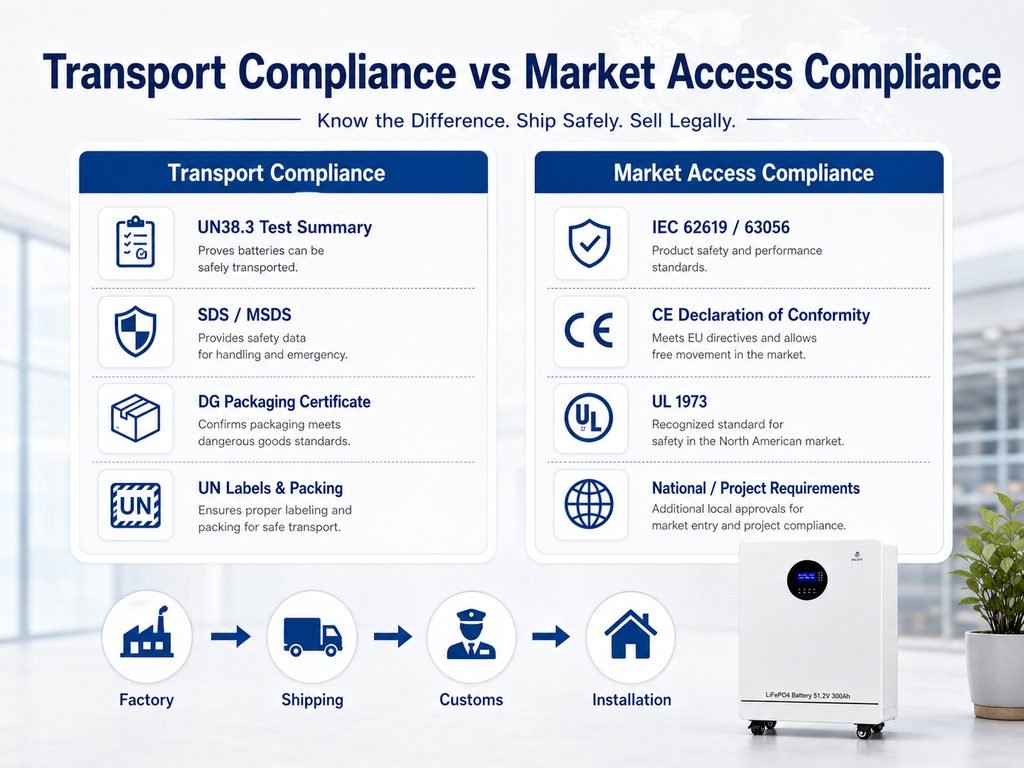
It also helps to sort LiFePO4 battery certifications into two categories that are constantly conflated:
- Transport compliance — proving the battery can be moved safely. UN38.3, SDS, packaging certification, UN numbers and labelling.
- Market access compliance — proving the battery can be legally sold and installed at destination. CE, UKCA, UL, IEC test reports, national approvals.
A supplier can be perfect on the first and useless on the second. Cargo that arrives at the port and cannot be installed is not a better outcome than cargo that never left.
The 8 Documents, One by One
1. UN38.3 Test Summary
What it is: evidence that the cell or battery has passed the transport safety tests defined in the UN Manual of Tests and Criteria, Part III, sub-section 38.3.
The test series covers altitude simulation, thermal cycling, vibration, shock, external short circuit, impact or crush, overcharge and forced discharge — a mix that applies differently to cells and to assembled batteries.
Since 1 January 2020, manufacturers and distributors have been required to make a Test Summary available. This is the standardised document that carriers actually ask for. It is not the same as the full test report, and a supplier offering only a laboratory report cover page is not meeting the requirement.
What it does NOT cover: UN38.3 is a transport test. It says nothing about whether the product is safe to install in a home, whether it meets electrical safety requirements at destination, or whether it can legally be sold in your market. Suppliers who present UN38.3 as their headline “safety certification” are either confused or hoping you are.
Verification questions:
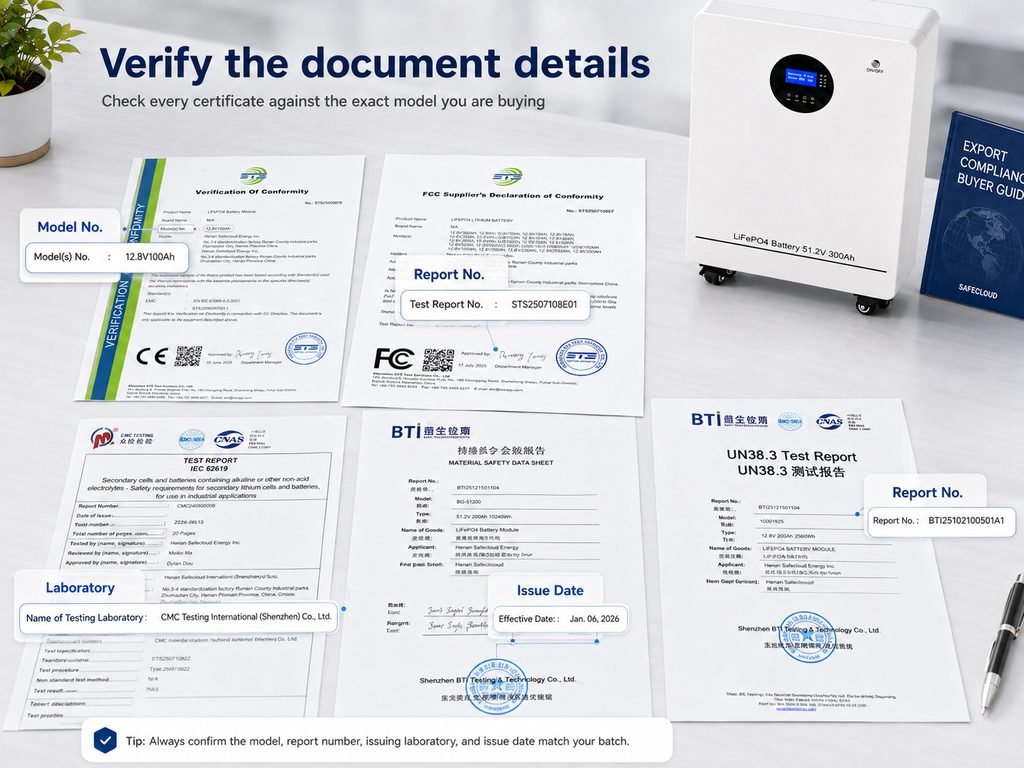
- Does the summary name the exact cell model and the exact battery model I am buying?
- What is the test report reference number and issuing laboratory?
- What date was it issued, and has the cell been changed since?
2. SDS / MSDS
What it is: the Safety Data Sheet, a 16-section document in GHS format describing chemical composition, hazards, handling, first aid, firefighting measures and disposal.
For lithium batteries the SDS is required by carriers, warehouses and many destination customs authorities. It is also what an emergency responder would reference in an incident.
What it does NOT cover: the SDS is not a test result and not a certificate. It is a disclosure document. Its presence proves nothing about product quality — it proves the supplier has documented the chemistry.
A common confusion worth clearing up: UN38.3 and SDS are frequently discussed as if they are alternatives. They are not. You need both, and they serve entirely different purposes.
Verification questions:
- Is it in the correct language for the destination country?
- Is it in current GHS format, and dated within the last three years?
- Does the product identification section match the model on the invoice?
3. Dangerous Goods Packaging Certificate (危包证)
What it is: for dangerous goods exported by sea from China, a two-part packaging certification is required — a performance certification held by the packaging manufacturer, and a use certification issued to the exporter for the specific shipment.
This is the single most common cause of a container being blocked at the terminal gate in China, and it catches buyers off guard because it is not a product certification at all — it is a packaging and exporter certification.
Why it matters to you as the buyer: a factory that primarily serves the domestic Chinese market may genuinely never have needed this. If your supplier does not hold current dangerous goods export qualification, your cargo does not load, regardless of how good the battery is.
Verification questions:
- Does the supplier hold current dangerous goods export qualification, and can they provide the certificate reference?
- Who is the exporter of record — the factory, or a trading company? The certification follows the exporter.
- Has this supplier shipped this product by sea to my region before, and can they name the forwarder?
That last question is the most efficient screening question in this entire article. A supplier with real export volume answers it immediately.
4. IEC 62619 / IEC 63056 Test Report
What it is: IEC 62619 specifies safety requirements for secondary lithium cells and batteries in industrial applications, including stationary energy storage. IEC 63056 builds on it with requirements specific to electrical energy storage systems.
Together these are the mainstream international safety reference for the products in this category, and they are increasingly requested directly by EPC contractors, insurers and grid operators.
Related standards you may see cited alongside:
| Standard | What it covers |
|---|---|
| IEC 62619 | Safety, industrial secondary lithium cells and batteries |
| IEC 63056 | Safety, lithium batteries for electrical energy storage systems |
| IEC 62620 | Performance, industrial secondary lithium cells and batteries |
| IEC 62477-1 | Safety of power electronic converter systems (relevant to all-in-one units) |
What it does NOT cover: an IEC test report is not by itself market access in any jurisdiction. It is technical evidence that supports a CE Declaration of Conformity, a national approval, or a customer’s due diligence — it is not a substitute for any of them.
Verification questions:
- Which edition of the standard was tested against?
- Was the test at cell level, module level, or complete system level?
- Which laboratory issued it, and is the report retrievable from that laboratory’s database?
5. CE Declaration of Conformity — EU lanes
What it is: this is the item most often misrepresented, so it is worth being precise. There is no such thing as a “CE certificate” issued by an authority for this product category. CE marking for batteries is a manufacturer’s self-declaration of conformity against the applicable EU legislation, supported by a technical file.
For a LiFePO4 energy storage product entering the EU, the relevant legislation typically includes the EMC Directive, RoHS, and the EU Battery Regulation (EU) 2023/1542, which replaced the old Battery Directive and phases in obligations including CE marking, carbon footprint declaration for larger industrial batteries, and a digital battery passport.
One technical detail that trips people up: the Low Voltage Directive applies from 75V DC upward. A 51.2V pack therefore falls below LVD scope, while a 345.6V high-voltage system falls within it. Different products in the same catalogue can have genuinely different applicable directives — a supplier who applies one blanket answer to their whole range has not done the work.
What to look for: a Declaration of Conformity naming the manufacturer, the product model, the specific directives and harmonised standards applied, and a signature. Not a certificate with a laboratory logo, which is a test report and a different thing.
Verification questions:
- Can I see the DoC itself, naming this model?
- Which directives and harmonised standards are listed on it?
- Who is the EU authorised representative or importer of record?
A warning worth taking seriously: if a supplier’s product page lists “CE” as a certificate alongside UN38.3 and RoHS with no DoC available, treat the entire certification list as unverified until proven otherwise. Under the EU framework, the party placing the product on the market carries the liability — and if you are the importer, that party is you.
6. UL 1973 / UL 9540A — North American lanes
What it is: UL 1973 covers batteries for stationary, vehicle auxiliary power and light electric rail applications. UL 9540 covers energy storage systems and equipment as a whole. UL 9540A is a test method for evaluating thermal runaway fire propagation — not a certification, despite constantly being listed as one.
For North American projects, particularly anything requiring an inspection sign-off, UL listing is frequently non-negotiable. Many authorities having jurisdiction will simply not approve an installation without it.
The most common misrepresentation in this industry: a supplier lists “UL” in a certification block on a product page, and the accompanying FAQ says they “can support customers with relevant certifications based on destination market”. Those two statements together almost always mean the product is not UL listed. Genuine UL listing comes with a file number that is publicly searchable in UL’s online certifications directory.
Verification questions:
- What is the UL file number, and which models does it cover?
- Is this a UL Listing or a UL Recognized Component?
- Was UL 9540A testing performed, and can I see the test data?
If a supplier cannot produce a searchable file number, they are not UL listed. This takes two minutes to check and it is the single highest-value verification step for any North American project.
7. Certificate of Origin
What it is: documentation of where the goods were manufactured, used for customs clearance and for claiming preferential tariff treatment under a trade agreement.
The form varies: a general Certificate of Origin, a FORM E for China–ASEAN, an RCEP certificate of origin, and others depending on the trade relationship.
Why it matters commercially: in markets where a preferential rate is available, the correct origin document is worth real money on landed cost. Buyers frequently discover after the fact that they paid a general tariff rate on goods that qualified for a preferential one.
Verification questions:
- Which origin form applies to my destination country?
- Does the HS code on the certificate match the code on the invoice and packing list?
Lithium-ion accumulators generally classify under HS heading 8507.60, but the applicable subheading and any national extensions should be confirmed with your customs broker.
8. Model-Specific Product Test Report
What it is: the full test report behind whichever standard applies, naming your exact product configuration.
This is separate from the summary documents above because a summary tells you a test happened; the report tells you what was actually measured. For any project of meaningful size, ask for the report.
Verification questions:
- Does the model number on the report match the model number on the quotation exactly, character for character?
- Does the cell model named inside the report match the cell in the product I am receiving?
- What is the report date, and has the design been revised since?
UN38.3 vs IEC 62619 vs UL 1973: What Each One Does Not Cover
Buyers routinely accept one of these as if it substitutes for the others. It does not.
| UN38.3 | IEC 62619 / 63056 | UL 1973 | |
|---|---|---|---|
| Purpose | Transport safety testing | Product safety, industrial and ESS | Product safety, North American listing |
| Issued by | Test lab, summary from manufacturer | Test laboratory | UL, as a listing |
| Grants market access? | No | No, supports it | Yes, in North America |
| Required to ship? | Yes, universally | No | No |
| Required to install? | No | Often requested | Frequently mandatory (US/Canada) |
| Covers fire propagation? | No | Partially | Via UL 9540A test method |
Read the “Required to ship” and “Required to install” rows together. A shipment can be fully transport-compliant and completely unusable at destination. That is the scenario that costs importers the most money, because the cargo has already been paid for, shipped and cleared before the problem surfaces at inspection.
The Model-Matching Trap
This is the failure mode that causes more held shipments than any missing document, and it is worth understanding in detail because most suppliers will not raise it with you.
LiFePO4 battery certifications are evidence only for the exact configuration they were issued against.
Here is how it goes wrong in practice. A supplier holds a valid UN38.3 Test Summary for their 51.2V 100Ah wall-mounted pack. You order the 51.2V 200Ah version. The supplier sends the 100Ah summary, reasoning that it is the same cell, the same BMS family, the same enclosure design. From an engineering standpoint they may even have a point.
From a carrier’s standpoint, they do not. The dangerous goods desk compares the model number on the summary against the model number on the packing list, finds they differ, and the booking is refused. The container does not load. Your delivery date moves by three to five weeks while a new test is arranged or a new document is located.
The same trap appears in four other places:
- Cell substitution. The report names cell model X; the pack now contains cell model Y from a different supplier because of a procurement change. The document is void and often nobody has noticed.
- Configuration change. A capacity or series-count variant that was never separately tested.
- Document–invoice mismatch. The commercial invoice describes the goods differently from the certificate, the packing list and the carton marks. All four must agree.
- Wrong UN number. Batteries shipped alone versus packed with equipment versus installed in equipment carry different UN numbers and different packing instructions. Getting this wrong at booking causes problems at origin, transshipment or destination.
How to protect yourself, in three steps:
- Before ordering, send the supplier the exact model number and configuration you intend to buy and ask: “Please confirm every certificate you hold names this exact model, and send them.”
- Before shipping, ask your forwarder to run a document consistency check across the commercial invoice, packing list, UN38.3 summary, SDS, carton marks and label photographs. Any mismatch is cheaper to fix on paper than at the terminal.
- Write it into the PO. Add a clause requiring model-specific documentation as a condition of shipment, with the supplier bearing the cost of any delay caused by non-matching documents. Suppliers who object to this clause are telling you something useful.
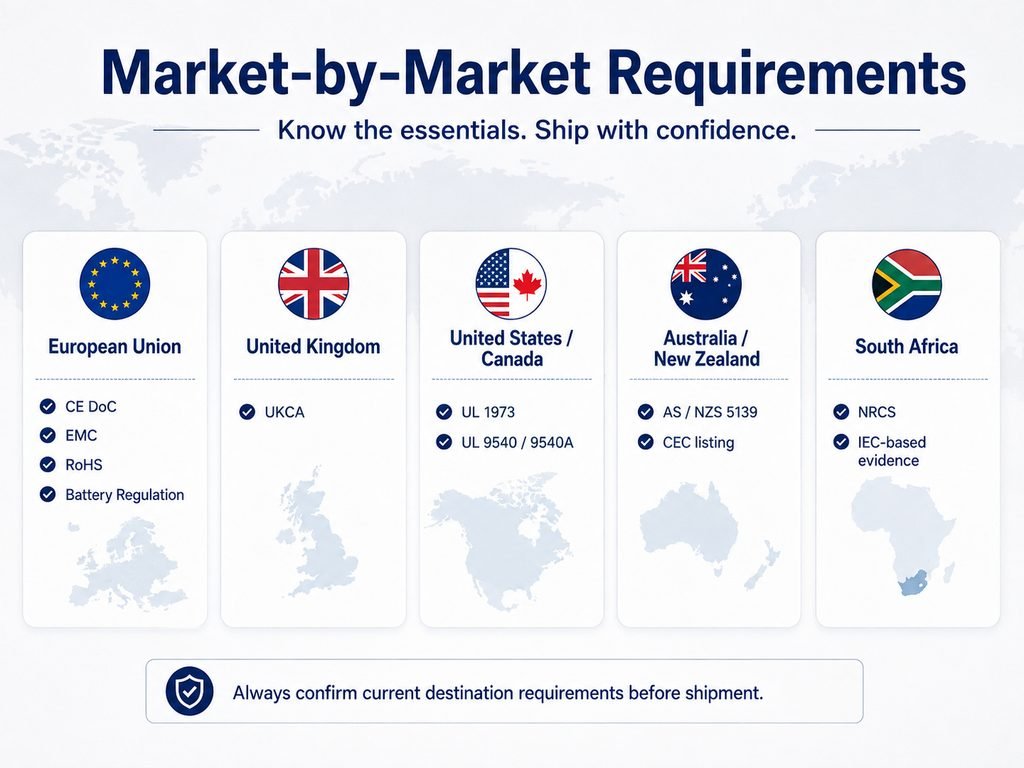
Market-by-Market Requirements
The LiFePO4 battery certifications required for market access differ sharply by region. The table below is indicative rather than exhaustive — confirm the current position for your specific product and destination.
| Market | Typical requirements beyond transport documents |
|---|---|
| European Union | CE marking with Declaration of Conformity; EMC, RoHS; EU Battery Regulation obligations phasing in; IEC 62619 / 63056 test evidence commonly requested; grid connection requirements vary by member state |
| United Kingdom | UKCA marking; broadly parallel technical requirements to the EU with separate conformity assessment |
| United States / Canada | UL 1973 and UL 9540 listing frequently mandatory for permitted installations; UL 9540A test data increasingly requested; NFPA 855 informs installation requirements; local AHJ approval |
| Australia / New Zealand | AS/NZS 5139 governs battery system installation; inclusion on the Clean Energy Council approved battery list is commercially decisive for the residential channel |
| South Africa | NRCS Letter of Authority for regulated products; IEC-based technical evidence |
| Middle East / Gulf | Requirements vary by country; several operate conformity assessment programmes requiring a certificate of conformity before clearance |
For any market on this list, the practical sequence is the same: identify the mandatory scheme first, then confirm your supplier holds evidence naming your exact model, then plan lead time around any testing gap.
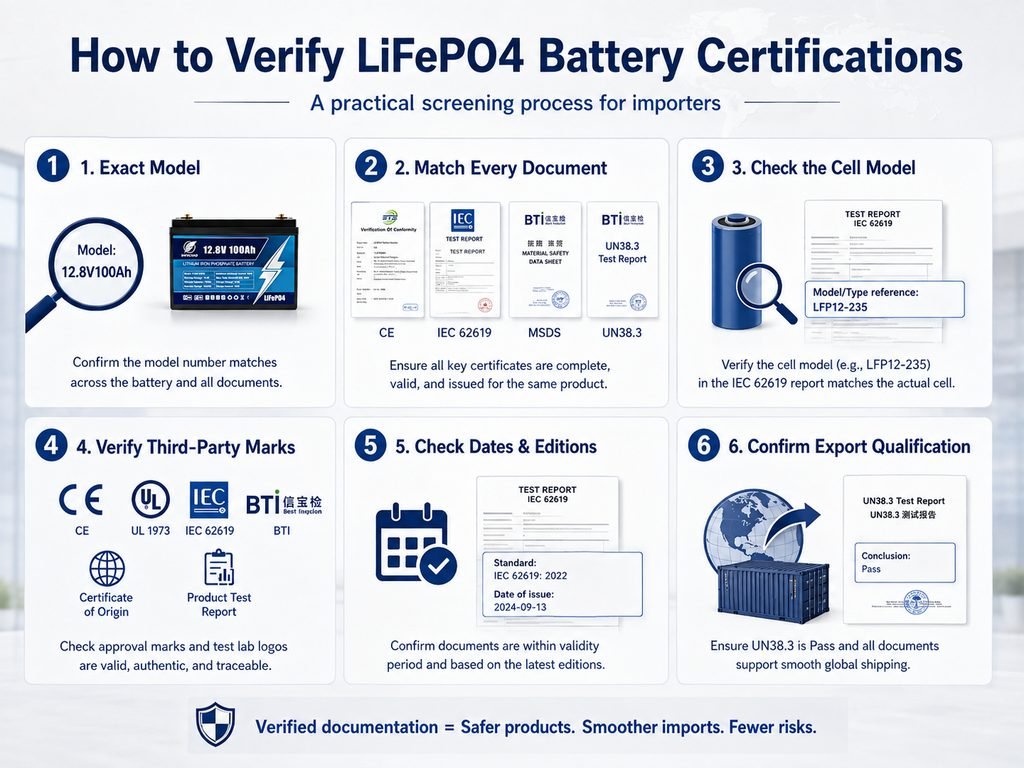
How to Verify LiFePO4 Battery Certifications
A six-step verification process that takes about an hour and prevents most problems:
- Ask for the document set naming your exact model — not the product family, not a similar capacity.
- Check every model number against your quotation, character for character, including suffixes.
- Check the cell model named inside the reports matches the cell that will be in your product, and ask who manufactures it.
- Verify third-party marks independently. UL listings are searchable by file number. Test laboratories can confirm report authenticity. Do not rely on a PDF a supplier emailed you.
- Check the dates. A report from four years ago against a superseded edition of a standard may not satisfy a current requirement.
- Confirm export capability, not just product capability. Ask specifically whether the supplier is the exporter of record and holds current dangerous goods export qualification.
If a supplier resists any of these six steps, that resistance is your answer. Every one of them is routine for a manufacturer with genuine export volume.
For the technical side of supplier verification — how to assess the performance claims rather than the compliance claims — see our companion guide to LiFePO4 battery cycle life.
Working With SafeCloud Power
SafeCloud Power supplies LiFePO4 energy storage systems to distributors, solar installers, EPC contractors and OEM/ODM partners, and we handle documentation the way this article recommends.
- Every certificate we provide names the specific model you are purchasing. If a variant has not been separately tested, we tell you before you order rather than at the booking stage.
- We state clearly which LiFePO4 battery certifications we hold and which we do not for each destination market. Where a gap exists, we quote the testing lead time honestly rather than listing a mark we cannot evidence.
- Cell manufacturer and cell model are disclosed on every product, so the reports and the hardware can be cross-checked.
- We support the full export document set for sea freight, including dangerous goods packaging documentation.
If you are evaluating a supplier and want a second opinion on a certification package you have been sent, send it over with your destination market. We will tell you what it covers, what it does not, and what is missing — including in the cases where the answer is that it looks fine.
Request the full document set for your market →
FAQ
Is UN38.3 a safety certification for LiFePO4 batteries?
No. UN38.3 is a transport testing requirement from the UN Manual of Tests and Criteria. It demonstrates the battery can be shipped safely under defined conditions. It says nothing about electrical safety in installation, fire performance in a building, or legal market access. Products need UN38.3 to move and separate certification to be sold and installed.
What is the difference between UN38.3 and MSDS?
They are different document types serving different purposes and you need both. UN38.3 is evidence of passing transport safety tests. The SDS/MSDS is a chemical hazard disclosure document in GHS format covering composition, handling, first aid and emergency response. Neither substitutes for the other.
Do I need CE certification for LiFePO4 batteries in Europe?
You need CE marking, but the phrase “CE certification” is misleading — CE marking for this product category is a manufacturer’s declaration of conformity supported by a technical file, not a certificate issued by an authority. Ask for the Declaration of Conformity naming your model and listing the specific directives and harmonised standards applied. Note that the EU Battery Regulation has introduced additional obligations phasing in through 2027.
Is UL certification required for LiFePO4 batteries in the United States?
For permitted stationary installations, UL 1973 and UL 9540 listing is frequently required and many authorities having jurisdiction will not approve an installation without it. Verify any UL claim by searching the file number in UL’s online certifications directory — a supplier who cannot provide a searchable file number is not listed.
Why was my lithium battery shipment held at the port?
The most common causes are a document–cargo mismatch (model numbers, quantities or descriptions differing between the certificate, invoice, packing list and carton marks), an incorrect UN number for the packing configuration, missing dangerous goods packaging certification at origin, or labelling that does not match the declared classification. Most of these are preventable with a document consistency check before the container is booked.
Can a supplier use a UN38.3 report from a similar model?
Carriers and dangerous goods desks generally require the documentation to name the model being shipped. A report covering a similar capacity or a different enclosure is likely to be rejected, and the resulting delay typically runs several weeks. Always confirm model-specific documentation before placing the order, and make it a condition of the purchase order.
Which certifications should I ask for first when screening a new supplier?
Screen LiFePO4 battery certifications with three questions in this order: can you provide a UN38.3 Test Summary naming this exact model; do you hold current dangerous goods export qualification as the exporter of record; and what is your UL file number or CE Declaration of Conformity for my destination market. A supplier with real export experience answers all three within a day. One who does not is going to be a problem later.
SafeCloud designs and manufactures LiFePO4 energy storage systems for residential, commercial and project applications, with OEM/ODM support for global partners. This article is general guidance, not legal or regulatory advice — confirm current requirements for your product and destination market with your freight forwarder, customs broker and the relevant national authority.