
Telecom Backup and Solar Street Light Battery Supply
- IP67 sealed packs for pole mounting
- Wide operating temperature range
- Low self-discharge for long standby
- Rack formats for base-station cabinets
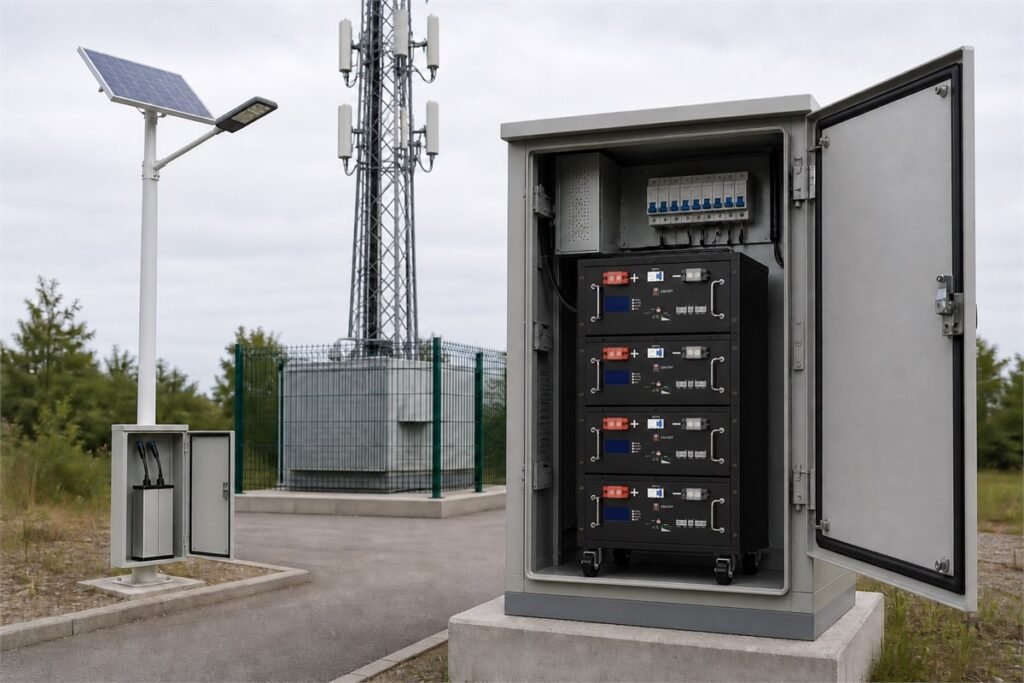
Catalog range
12.8 V / 25.6 V · 30 – 60 Ah · 384 Wh – 1.536 kWh · plus 48 V rack
Who buys infrastructure batteries
Solar street light manufacturers
- IP67 metal case
- Mounting behind the panel or in the pole
- Multi-protection BMS
Telecom infrastructure contractors
- 19-inch rack format
- RS485 monitoring
- Long standby, low self-discharge
Municipal and infrastructure tenders
- Consistent specification across batches
- Tender-ready documentation
- Volume planning
The failure that costs money is the site visit, not the battery
| Design driver | Consumer logic | Infrastructure logic |
|---|---|---|
| Enclosure | Adequate for indoor use | IP67, sealed against immersion |
| Temperature range | Typical climate | Worst recorded local extreme |
| Autonomy | Average night | Longest overcast run of the year |
| Self-discharge | Rarely considered | Critical — months of standby |
| Monitoring | Optional convenience | Avoids diagnostic site visits |
| Replacement cost | Battery price | Battery plus access equipment plus labour |
Platforms specified for outdoor infrastructure
Solar street light packs — IP67
- 30 – 60 Ah, 384 Wh – 1.536 kWh
- IP67 metal case
- ≥ 3,000 cycles
FT-B sealed series — IP64
- 12.8 V and 25.6 V
- 200 A / 400 A peak
- ≥ 4,000 cycles
51.2 V rack batteries
- 5 – 15 kWh per shelf
- CAN / RS485
- Parallel expansion
What to specify for an unattended outdoor asset
IP67 versus IP64 — be honest about the position
Design for the worst night, not the average
Self-discharge over long standby
Temperature range at the real extreme
Remote monitoring pays for itself
Anti-theft and mechanical security
Sizing a street light or backup pack
| Installation | Nightly load | Autonomy target | Suggested pack |
|---|---|---|---|
| 30 W all-in-one street light | ~0.24 kWh | 2 – 3 nights | 12.8 V 30 – 40 Ah |
| 60 W split solar street light | ~0.48 kWh | 3 nights | 12.8 V 60 Ah |
| 100 W road lighting | ~0.80 kWh | 3 nights | 25.6 V 60 Ah |
| Remote monitoring / camera site | 0.1 – 0.4 kWh | 5 – 7 days | 12.8 V 60 Ah or 25.6 V 40 Ah |
| Small repeater backup | 1 – 3 kWh | 8 – 12 hours | 51.2 V rack, 5 kWh |
| Base-station backup | 5 – 15 kWh | 4 – 8 hours | 51.2 V rack, paralleled |
Documentation for infrastructure and tender supply
- UN38.3 Test Summary and SDS for every shipment
- Dangerous goods packaging documentation for sea freight
- IP rating test evidence for the specific enclosure
- IEC 62619 test evidence where the tender requires it
- CE Declaration of Conformity for EU placement
- Consistent batch specification across a multi-year fleet rollout
What can be configured for an infrastructure programme
- Enclosure format, fixing points and mounting interface
- IP rating and cable gland specification
- Capacity, BMS thresholds and low-voltage cut-off
- Self-heating for cold-climate deployments
- RS485 monitoring and remote reporting options
- Marking, asset labelling and anti-theft features
Technical and purchasing questions
IP64 covers dust ingress and splashing water. IP67 withstands temporary immersion. For pole bases that flood, buried enclosures or coastal sites, IP67 is the requirement. Tell us the physical position and we will specify against it rather than assume.
The packs are specified at 3,000 cycles or more. In street lighting the battery typically cycles once per night, so calendar life and temperature exposure usually determine replacement rather than cycle count. Design the enclosure and thermal path accordingly.
Discharge operates across a wide range, but charging below 0 °C is blocked by design to prevent permanent damage. For cold sites, specify the self-heating option. For hot sites, ask for the derating position — sustained high temperature shortens life materially.
RS485 monitoring is available on rack formats and as an option on selected packs. On a dispersed fleet it usually pays for itself, because knowing which asset failed and why removes a diagnostic site visit.
Send the specification document. We will tell you clause by clause what we can evidence against the exact model, what would need testing, and what we cannot meet — including the cases where the honest answer is that we are not the right supplier.
Yes, and it should be. Lock the configuration at the start of the programme so every batch matches. If a component change becomes unavoidable we raise it before production rather than after delivery.