
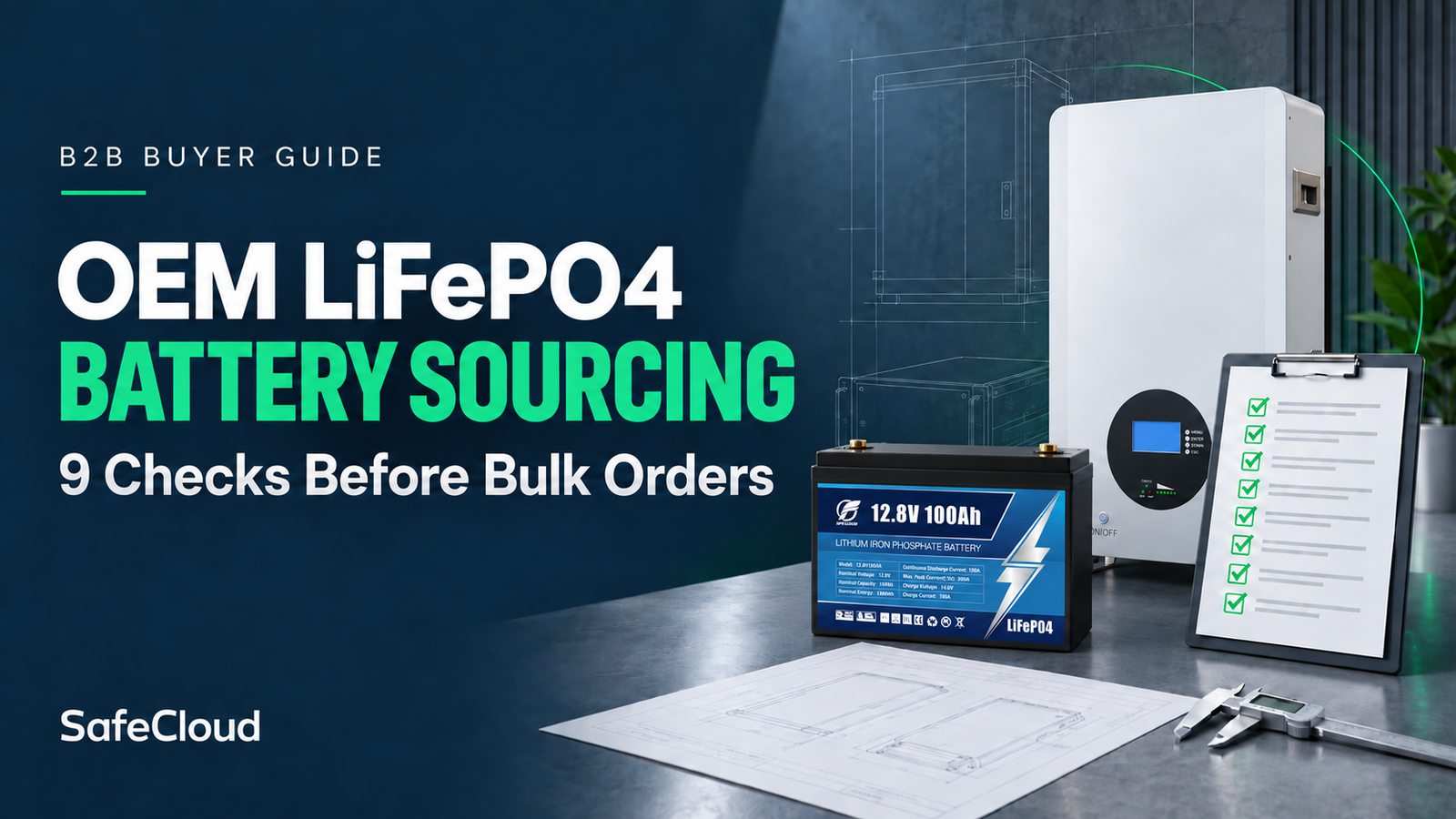
An OEM LiFePO4 battery order becomes easier to manage when the buyer approves a defined product, a test plan and a repeatable supply process together. For importers, distributors and project integrators, the first quotation is only one part of that decision. The important question is what evidence will support the product you receive in the first shipment and in later batches.
This guide provides nine procurement checks for stationary energy storage and related battery projects. It focuses on the decisions between the initial enquiry and production release. Use it to brief suppliers, compare offers and record what your engineering and purchasing teams have actually approved.
Quick answer: before placing a bulk order, agree on the application, supply scope, specification revision, integration evidence, document coverage, sample acceptance criteria, production traceability, commercial terms and release documents. Unresolved items should have an owner and a due date.
OEM LiFePO4 battery procurement: the nine-check overview
| Check | Evidence to request |
|---|---|
| 1. Project definition | Application brief and target-market requirements |
| 2. Supply scope | Responsibility matrix for branding, engineering and support |
| 3. Specification | Dated, model-specific technical schedule |
| 4. Integration | Inverter or equipment pairing record |
| 5. Documents | Reports and listings matched to the supplied configuration |
| 6. Sample acceptance | Measured results against agreed pass criteria |
| 7. Production consistency | Traceability and component-change procedure |
| 8. Commercial comparison | Comparable quotation and service terms |
| 9. Order release | Approved production and shipment document pack |
In this guide
- Define the project and supply scope
- Approve specifications and integration evidence
- Review documents and sample acceptance
- Control production and compare quotations
- Release the order and prepare your RFQ
- Frequently asked questions
1. Start with a project brief that purchasing and engineering share
A distributor building a product range and an EPC contractor supplying one site may ask for the same nominal battery capacity. Their approval criteria can still differ. The distributor needs repeatable stock, installer documentation and a service process across many locations. The contractor needs a configuration that fits a particular load, inverter, room and commissioning schedule.
Write the brief before comparing prices. State the destination country, application, expected operating hours, required backup duration, installation environment and first-order quantity. Separate firm requirements from preferences. A fixed cabinet footprint may be mandatory; a preferred display layout may be negotiable.
Give the supplier the operating constraints, including any missing measurements. An unknown peak load should remain an open engineering item rather than becoming a guessed specification in the quotation. For energy-storage projects, our battery sizing guide explains the distinction between energy demand and power demand.
Approval evidence: a one-page project brief, version number and named technical contact. Every shortlisted supplier should quote against the same version.
2. Define what your OEM LiFePO4 battery supplier will deliver
Suppliers use OEM, ODM and private-label terminology differently. Put the actual work into the purchase scope: applying your brand to an existing platform, adapting an enclosure or interface, or developing a new electrical and mechanical design. Each choice creates a different amount of engineering, testing and documentation work.
For an existing platform, identify the permitted changes and the documents available for that exact configuration. For a custom design, list the drawings, firmware configuration, tooling, prototypes and validation work expected. Specify who prepares the user manual and who approves translations and label artwork.
Agree who controls design files, who may use the tooling and how future revisions will be supplied. These are commercial decisions to record with your supplier; an OEM or ODM label does not settle them automatically.
Approval evidence: a responsibility matrix assigning each deliverable to the buyer, manufacturer or integration partner. Keep development charges separate from recurring unit prices so later comparisons remain meaningful.
3. Freeze a model-specific specification before sample approval
Create a technical schedule for the OEM LiFePO4 battery configuration under review. Include nominal energy, permitted operating voltage, continuous charge and discharge current, peak current with duration, temperature limits, physical dimensions, weight, mounting arrangement and environmental protection. Identify the exact model and revision on every page.
Keep nominal energy, usable energy and output power in separate fields. For example, 51.2 V × 200 Ah equals 10.24 kWh nominal energy. That calculation alone does not establish the energy delivered to an AC load or the continuous inverter output the pack can support.
Illustrative current check: supplying a 5,000 W AC load at an assumed 95% inverter efficiency and 51.2 V battery voltage requires about 103 A: 5,000 ÷ (0.95 × 51.2). At an assumed 46 V, the same calculation gives about 114 A. These are arithmetic examples, not a rating for a particular product. Confirm actual voltage limits, efficiency, temperature derating and surge requirements with the equipment suppliers.
For cycle-life claims, record the stated test conditions and end-of-life criterion. Our cycle-life verification guide covers the questions to ask. Attach any agreed exceptions to the schedule instead of leaving them in separate chat messages.
Approval evidence: a dated specification with buyer and supplier acceptance, plus a clearly identified list of unresolved items.
4. Verify the complete inverter or equipment pairing
An interface label such as CAN or RS485 is one item in an integration review. Request the battery model, BMS hardware and firmware versions, inverter model and firmware, communication cable specification and supported configuration. For multi-battery systems, include the approved unit count and the method used to aggregate battery information.
Victron publishes battery-specific compatibility guidance and distinguishes documented tested combinations from other third-party arrangements requiring supplier support. This is a useful example of the level of detail buyers should request. A listing for one product does not establish compatibility for a different branded pack.
Ask for a pairing record showing the tested versions, operating modes and results. The sample plan should cover normal charge and discharge, system restart, reported state of charge and documented behavior if communication is interrupted. Qualified personnel should carry out these checks using the manufacturers’ procedures.
For an OEM LiFePO4 battery project, decide who owns troubleshooting when the battery and inverter come from different companies. Include log-file collection, technical contacts and the process for approving firmware changes.
Approval evidence: a configuration-specific integration record. Treat a brand-logo sheet as a starting point for questions.
5. Match safety and transport documents to the actual product
Build a document register before committing to a destination market. For each document, record the issuing organization, report or listing reference, applicant, product model, configuration and applicable standard edition. Ask the supplier to explain any difference between the model on the quotation and the model on the report.
IEC 62619:2022 addresses safety requirements and tests for secondary lithium cells and batteries in industrial applications, including stationary applications. Its scope should be read alongside the requirements of the intended product and installation.
UL distinguishes battery evaluation under UL 1973, energy storage system evaluation under UL 9540 and thermal-runaway fire-propagation testing under UL 9540A. The UL energy storage overview explains these roles. A battery-level document should not be presented as proof that an entire proposed installation has been approved.
For transport, request the applicable UN 38.3 test summary and have your logistics provider confirm the shipment requirements. IATA’s shipping guidance explains the availability of test summaries and the possibility of additional airline or state restrictions.
Use our battery document guide to organize the request. The required package depends on the destination, transport mode and system configuration; this checklist is not a universal market-access approval.
Approval evidence: a model-matched document register, with remaining compliance questions assigned to the supplier, test organization or relevant project specialist.
6. Approve samples against measurable acceptance criteria
Write the sample acceptance plan before the sample arrives. Define the test configuration, instruments, conditions, result format and acceptable limits. This allows both parties to distinguish a product defect from an incomplete installation, a settings issue or a requirement that was never agreed.
| Review area | What the acceptance record should show |
|---|---|
| Energy and current | Measured results, operating conditions and comparison with the approved specification |
| System operation | Exact battery and inverter versions, settings, operating modes and observed faults |
| Physical fit | Dimensions, connector access, mounting and service clearance |
| Documentation | Matching model identifiers, labels, manuals and supplied accessories |
A sample that starts the equipment successfully has passed one observation. Record performance across the agreed operating envelope and retain the logs. Route protection or abnormal-condition testing through qualified personnel and appropriate facilities; procurement teams should request evidence rather than improvise destructive tests.
If a sample fails, issue a deviation record containing the symptom, test conditions, proposed correction and retest requirement. Accepting a revision should update the specification and the sample record together. For an OEM LiFePO4 battery program, retain a reference sample or an equally clear configuration record that later shipments can be checked against.
Approval evidence: a completed acceptance report with each requirement marked pass, fail or open. Define the pilot-order exit criteria before authorizing a larger batch.
7. Make production consistency and traceability auditable
Ask how a finished battery serial number connects to its build configuration and final inspection record. Request an example with confidential customer information removed. The useful result is a retrievable record that identifies what was built, which specification applied and what was checked before release.
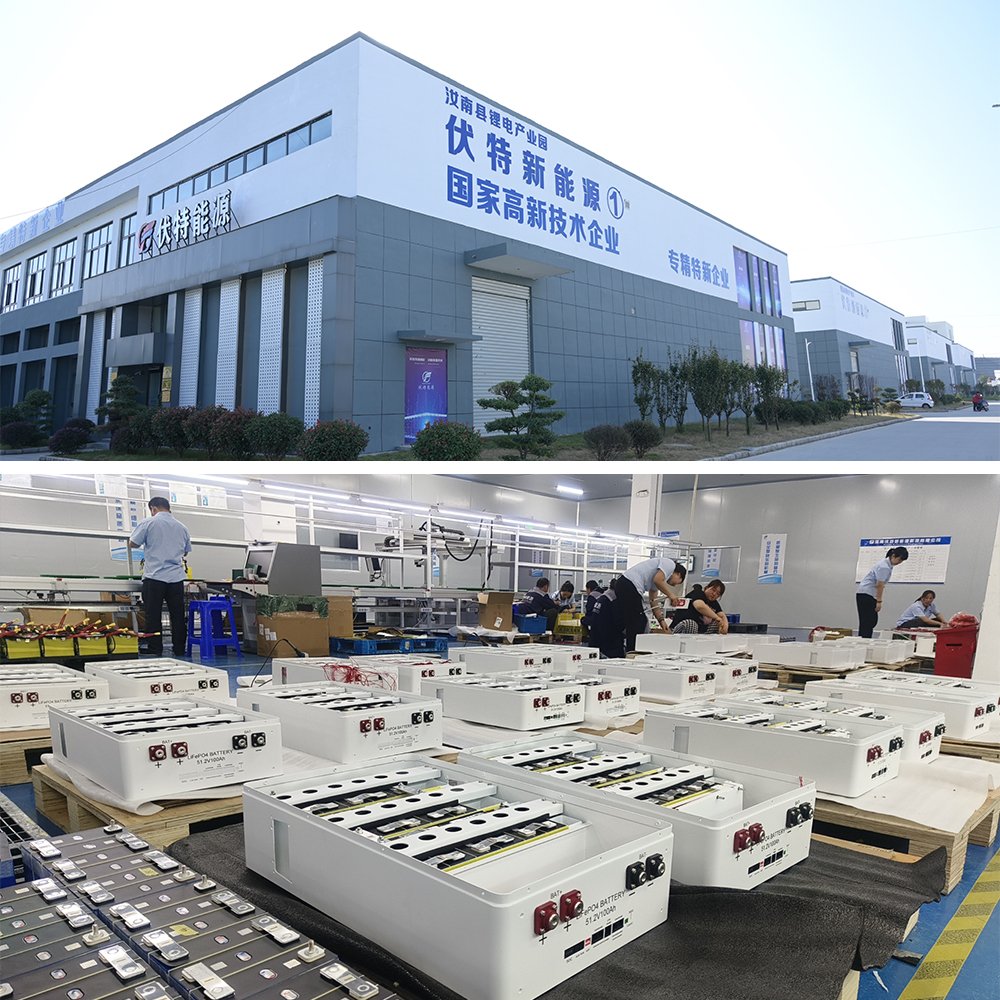
The production agreement should identify controlled components and revisions. Define which substitutions require written approval, which tests must be repeated after a change and how affected stock will be identified. Include a process for discontinued components, because repeat orders may span more than one component purchasing cycle.
Review a worked traceability example during a factory review: select a finished serial number, retrieve its record and compare it with the approved build. This gives the buyer a concrete basis for evaluating claims about inspection and consistency.
A factory photograph is useful context, but the acceptance decision should rest on the records relevant to your order. Ask about the inspection stages, record retention and treatment of nonconforming units.
Approval evidence: a sample traceability record and a written change-notification procedure. These should remain accessible to the people handling field service.
8. Compare the full quotation and after-sales responsibility
Normalize every OEM LiFePO4 battery quotation to the same configuration, quantity and delivery basis. List the included cable set, mounting parts, communication accessories, packaging, manuals and testing. A low unit price can be difficult to interpret when another offer includes items that the project will have to purchase separately.
Separate recurring supply costs from engineering, tooling and validation costs. Ask which milestones start the quoted lead time: specification approval, artwork approval, deposit, component availability or sample sign-off. Record the assumptions behind the production slot and the action required if an assumption changes.
For distributors, review the service process with the same care as the purchase price. Clarify the warranty start date, evidence required for a claim, response responsibilities, spare-parts availability and allocation of transport or replacement labor costs. Avoid promising your customers broader coverage than your supplier agreement supports.
Use a comparison sheet with an ‘excluded or unresolved’ column. A supplier with a documented exception can be evaluated; an unrecorded assumption will usually surface later, when the order is harder to change.
Approval evidence: comparable quotations and an agreed commercial schedule covering delivery, service and exceptions.
9. Release the bulk order with a controlled document pack
Before release, bring the approved specification, sample report, document register, label artwork, packing requirements and commercial schedule into one indexed package. Give it a revision and make that revision part of the purchase order. The production team should be able to identify the approved build without reconstructing an email chain.
Define the shipment-release evidence in advance. Depending on the order, it may include a serial-number list, agreed inspection results, packing list, label photographs and confirmation of included accessories. State who reviews it and how deviations are resolved.
Plan the receiving inspection as well. Check shipping condition, identifiers, quantities and agreed documents before the batteries enter stock or installation. Keep the receiving records linked to the supplier’s shipment references so a later issue can be traced to the relevant batch.
For an initial OEM LiFePO4 battery purchase, a controlled pilot can establish whether the approval process works in practice. The pilot quantity and duration should follow the project’s risks and validation needs rather than an arbitrary universal number.
Approval evidence: a released order package and a receiving checklist with named owners.
Copy this OEM LiFePO4 battery RFQ checklist
Send the following information with your request for quotation. Mark unknown items clearly and ask the supplier to identify any assumptions in its response.
- Buyer and market: company, role, destination country, application and intended sales or installation channel.
- Demand: sample quantity, pilot quantity, expected repeat-order volume and required delivery milestones.
- Electrical requirement: nominal and operating voltage, energy requirement, continuous power or current, peak demand with duration and charging window.
- System pairing: inverter, charger or equipment make and model; firmware version if available; required communication.
- Site and enclosure: dimensions, mounting, weight limits, ambient conditions and indoor or outdoor location.
- Customization: logo, color, labels, interfaces, manual languages, packaging and any required engineering changes.
- Evidence: applicable reports, configuration references, sample test plan and production inspection requirements.
- Commercial scope: delivery basis, included accessories, development charges, warranty responsibilities and quotation validity.
Ask the supplier to return three clearly separated lists: confirmed requirements, proposed alternatives and unresolved items. This makes the first engineering discussion more useful and helps purchasing compare responses consistently.
Discuss your project with SafeCloud
Explore SafeCloud’s home energy storage battery platforms and OEM/ODM services, then send the checklist with your enquiry. Request confirmation of the exact configuration, documentation scope, sample plan, minimum order quantity and lead time for your project.
For a tailored review, submit your battery project requirements. Include the target market and inverter or equipment model so the discussion can begin with integration and purchasing requirements.
OEM LiFePO4 battery sourcing FAQ
What is the difference between OEM, ODM and private-label supply?
The labels vary between suppliers. Define the deliverables in writing: use of an existing platform, branding changes, engineering changes, ownership of design files and the validation work included. The agreed scope is what purchasing and engineering can verify.
What is a reasonable minimum order quantity?
There is no single MOQ that applies to every OEM LiFePO4 battery. Existing platforms, custom tooling, component purchasing and packaging can create different constraints. Request separate sample, pilot and production quantities, together with any one-time charges.
Does CAN communication prove inverter compatibility?
It does not establish a complete pairing. Ask for the exact battery and inverter models, firmware, cable requirements and configuration-specific test evidence. Record who supports the combination and how future firmware changes will be handled.
Can a certification for one battery cover my branded version?
Coverage must be confirmed for the model, configuration and branding arrangement being supplied. Ask the supplier and relevant certification organization to identify the applicable scope and any additional evaluation or documentation needed.
How should I choose between two similar quotations?
Compare the accepted technical configuration, included accessories, evidence supplied, delivery assumptions and service obligations. Record unresolved items separately. Price becomes a useful decision factor once the offers describe comparable products and responsibilities.