
Home Energy Storage Battery Supply for Installers, Brands and Distributors
- 5.12 kWh to 35 kWh per unit
- Up to 15 units in parallel
- CAN / RS485 / RS232 closed loop
- Cycle life quoted with test conditions
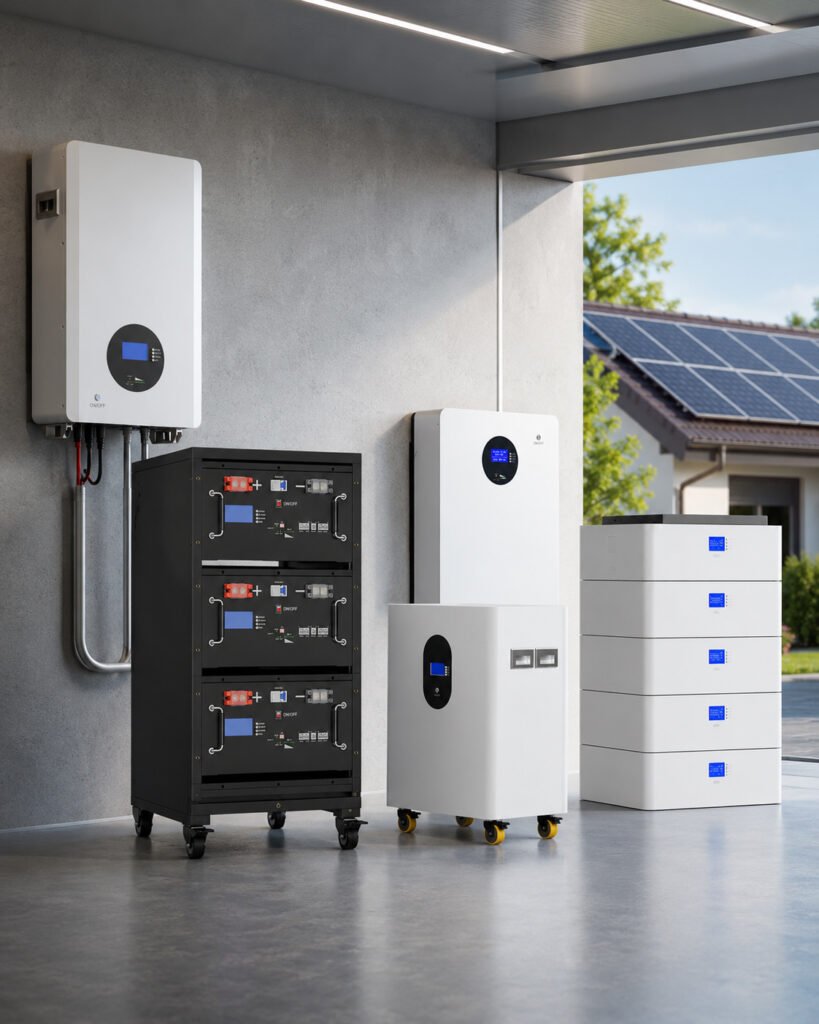
Catalog range
51.2 V · 100 Ah – 684 Ah · 5.12 – 35.02 kWh per unit
Who specifies these systems
Solar installers
- Inverter protocol confirmation
- Wall, stack, floor and rack formats
- Commissioning documentation
Energy brands and retailers
- Enclosure appearance and branding
- App and monitoring options
- Market-specific certification scope
Distributors and wholesalers
- Consistent 51.2 V platform
- Volume planning and repeat supply
- Datasheets and compliance files
Form factor is an installation decision before it is a product decision
| Format | Typical unit size | Best where |
|---|---|---|
| Wall-mounted | 5.12 – 10.24 kWh | Garage or utility wall, limited floor area |
| Stackable | 2.5 – 5 kWh per module | Capacity grows over time, tight footprint |
| Floor-standing cabinet | 16 – 35 kWh | Plant room, villa, light commercial |
| Rack-mounted | 5 – 15 kWh per shelf | Existing 19-inch rack, telecom-style install |
| All-in-one | 10 kWh + 5 kW inverter | Single-box retrofit, no separate inverter |
Platforms specified for residential storage
LD floor-standing cabinets
- 16 kWh / 20 kWh / 35 kWh
- 6,000 cycles at 25 °C, 80 % DOD
- 15 units in parallel
Wall, stack and rack systems
- 5.12 – 20.48 kWh per unit
- CAN / RS485, optional Bluetooth / WiFi
- 1 – 15 in parallel
All-in-one battery and inverter
- 10.0352 kWh battery
- 5,000 W output
- 1 – 9 in parallel, 10 / 20 ms transfer
What decides whether commissioning goes smoothly
Inverter model and firmware, not brand
Indoor rating versus installation position
Parallel count and current sharing
Cycle life against the tariff
Access, floor loading and handling
Certification scope for the market
Sizing from consumption and tariff, not from roof size
| Household profile | Evening + overnight use | Suggested capacity |
|---|---|---|
| Apartment, no solar, tariff shifting only | 2 – 4 kWh | 5 kWh |
| Small house with rooftop solar | 4 – 7 kWh | 10 kWh |
| Family house, solar plus EV overnight | 8 – 14 kWh | 15 – 20 kWh |
| Large villa, whole-home backup | 15 – 25 kWh | 20 – 35 kWh |
| Off-grid house, multi-day autonomy | 10 – 20 kWh per day | 35 kWh and above, paralleled |
| Light commercial, evening peak cover | 20 – 40 kWh | 35 kWh, two or more units |
What a residential installation typically needs
- UN38.3 Test Summary and SDS for every shipment
- Dangerous goods packaging documentation for sea freight
- CE Declaration of Conformity for EU placement
- IEC 62619 / IEC 63056 test evidence, commonly requested
- UL 1973 and UL 9540 listing for permitted North American installs
- AS/NZS 5139 context and CEC listing for the Australian channel
What can be configured for a residential storage line
- Capacity, module count and expansion path
- Inverter protocol set and default addressing
- Enclosure colour, finish, logo and label
- Touch LCD screen, Bluetooth telemetry, iOS / Android app
- Self-heating kit and active fire suppression module
- Manual, quick-start guide, carton and pallet configuration
Technical and purchasing questions
Mainstream hybrid brands including Deye, Solis, GoodWe, Growatt, Sofar and SMA over CAN, RS485 or RS232. Protocol selection is model-specific, so send the exact inverter model and firmware version and we confirm the setting rather than asking you to work through the menu on site.
Up to 15 for the 51.2 V platforms, and 1 to 9 for the all-in-one system. Beyond a small number of units, confirm total current, busbar and cable sizing, protection coordination and address settings for the specific project.
It is specified at 25 °C ambient and 80 % depth of discharge. Those conditions are part of the specification, not a footnote. A cycle figure quoted without a temperature and a depth of discharge cannot be compared with it.
The floor-standing cabinets are rated IP20 and are for indoor installation in a dry, ventilated space. For outdoor projects, tell us the site conditions at quotation and we will advise on an alternative rather than let an indoor-rated unit go outside.
Wall-mounted for garage and utility walls with limited floor area, stackable where capacity grows over time, floor-standing for villa and plant-room installs, rack where a 19-inch rack already exists. Format is an installation constraint; decide it before capacity.
It depends on the destination. EU placement needs a CE Declaration of Conformity; North American permitted installs frequently require UL 1973 and UL 9540 listing; the Australian residential channel effectively requires CEC listing. Tell us the market and we will confirm what we hold and what we do not.